
Glandore Pulse Survey 2026

Foreword
It gives us great pleasure to present the inaugural Glandore Pulse Survey. We are publishing it to mark 25 years in business across the whole of Ireland, as a pioneer in flexible workspace. As the name suggests, this survey takes the pulse of a diverse range of our members, from indigenous small and medium enterprises and international scaling businesses, to established multinationals. The data we refer to in this report is based on an in-depth questionnaire completed by 200 executives at member companies based in our office locations across the island of Ireland.
Their answers shed light on the trends shaping our members’ companies, the business opportunities they anticipate over the next 12 months, their growth expectations, challenges in the Irish market, their preferred working models, and what employees are asking for most in 2026. Artificial intelligence (AI) is one of the most talked-about technologies of our time, sitting somewhere between hyped and hoped-for. We were keen for our members to have their say, and they have some surprising takes on AI’s anticipated impact for them.
Here are some of the headline figures that immediately catch the eye:
- 82.6% of businesses are confident in their growth over the next 12 months
- 68.1% of businesses in our survey expect to hire more staff this year
- 73.8% of businesses use a hybrid working model, combining office and remote work
- 77.9% say hybrid working has had a positive impact on their business
- 72.7% say flexibility ranks above pay as employees’ main motivation.
We believe this is a valuable snapshot into the primary concerns of SMEs around Ireland, at a time when flexible and hybrid working models are often a key lever for attracting and retaining talent; and when the effects of AI and automation are starting to be felt across all industries.
A note on our survey methodology and sample profile
Most of our respondents work in small, scaling businesses in the Republic of Ireland and Northern Ireland. Almost half (47.1%) have fewer than 10 people and just over a quarter (26.2%) have teams sized between 11-25 people. One in seven (14.5%) work in companies with 26-50 staff, while 5.8% have 51-100. The remaining respondents work in companies with more than 100 employees.
The group represents a cross-section of industry sectors including professional services, technology, life sciences, financial services or fintech, and real estate. Their roles span many business functions from executive leadership to sales and business development, technology and engineering and marketing/communications, and finance and compliance.
Just over one-third of our respondents (35.5%) work at companies that are headquartered in Ireland. The next largest group comes from UK companies, at 22.7% of the total. Closely behind, one in five respondents are from companies with headquarters in the USA (20.9%). Businesses from Europe make up 8.1% of our survey group, with 4.7% representing firms from the Asia-Pacific region.
Glandore has offices in Dublin, Belfast and Cork so this should not be considered a nationally representative sample. The survey was conducted online in January and February 2026.
Hybrid work, company culture and the employee experience
The world of work looks radically different to how it did just a decade ago, and it is affecting the office workspace. Our survey is clear: hybrid working is the dominant working model, but our research also reflects a trend towards a return to the office: 42.4% of our members say their teams spend 1-2 days per week in the office and a further 31.4% ask staff to come in to the office 3-4 days out of the working week. At either end of the scale, 8.7% are fully remote while 8.1% are fully office‑based. Interestingly, a slightly higher number – 9.3%, or almost one in ten – have no formal policy on their preferred work style.
To put these findings in context, the latest labour force data from the Central Statistics Office shows that 956,700 people worked remotely or in hybrid arrangements in the fourth quarter 2025. The annual average for remote working during the whole of 2025 was 35.4% of the total workforce. This is up by 4.7% compared to 2024 and these are the highest figures ever recorded for remote working. In 2019, the last full year before the Covid-19 pandemic led to widespread office closures, the percentage of the workforce that worked remotely or hybrid was 20.3%.
To delve deeper, we asked about the impact of a hybrid approach on company culture. Almost 80% of our members believe this flexible approach to working has been positive: 34.3% say the impact has been very positive and 43.6% told us that hybrid work has had a somewhat positive impact on culture. Although it’s the majority, the sentiment isn’t shared by everyone: close to 10% of members believe that hybrid working has had a “somewhat” or “very” negative impact on culture.
We can draw some conclusions from this: the office is now a collaboration hub, not a daily workplace. Choosing a hybrid working model has an effect on a company’s choice of office environment. Flexible workspaces are an obvious solution for companies that need to accommodate varying numbers of people in the office in a typical working week, and to scale up or down as their needs require.
This makes the following elements critical:
- Meeting rooms
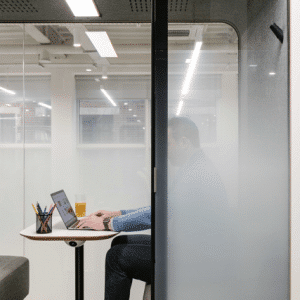
- Zoom-friendly booths
- Comfortable workspaces
- Community atmosphere
Team growth in 2026
Businesses hire when they’re confident about the future, and our survey reflects this positive mood with almost seven out of ten planning to grow their teams over the next 12 months. This breaks down as 14% expecting significant expansion in staff numbers, and 54.1% anticipating moderate growth. 29.1% expect no change.
For all the talk in certain circles that AI could place certain jobs at risk, our survey suggests otherwise. More than half of our respondents (51.7%) say AI will have no impact on their headcount in Ireland – almost four times more than the 13.4% who expect AI to lead to lower staff numbers. A surprising finding is that 7.6% expect AI to increase headcount. In some cases, this is impacting on the types of jobs, with respondents saying they plan to hire different skill sets.
Significantly, just over a quarter of our members haven’t reached any firm conclusions yet: 27.3% say it is too early to know.
Is hiring a challenge in today’s market?
Attracting and retaining talent is a live issue for most businesses. Our survey suggests hiring is challenging, but not uniformly severe. Most responses sit in the “somewhat challenging” and “challenging” range. Only a smaller share of our survey group say that hiring is “not very challenging”. Very few respondents describe hiring as “not challenging”, which would suggest they are generally able to source the talent they need.
What do employees want most in 2026?
We asked our members what their employees’ expectations are in 2026, and our immediate takeaway from this is: pay is not the primary driver for today’s workforce. Employees have equal focus on sustainable workloads as much as on financial security. Flexibility is the single most requested item, with nearly three out of four respondents (72.7%) placing it in their top three. Competitive salary (64.5%) and better work‑life balance (62.2%) follow closely.
Other employee requests that featured strongly in our survey include more professional development, with 29.1% of our respondents including this: reflecting a demand for career growth and skills building. At Glandore, we provide complimentary business coaching to members, along with networking opportunities to support their professional development.
An inspiring work environment ranked as important for one-fifth of our survey group (20.9%). Other employee ‘asks’ include better technology and tools (11.6%), wellbeing supports (8.1%), more in‑person collaboration (7.0%) and a stronger workplace community (5.8%). Taken together, these responses show a workforce that wants choice over how and where they work, fair pay, and meaningful investment in their development and wellbeing.
The future is flexible (workspace)
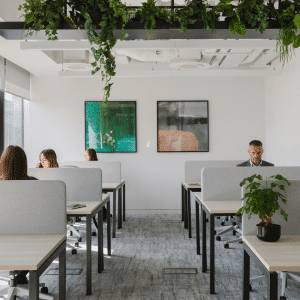
In light of the trends above, and the strong adoption of hybrid working models, it is no surprise that 44.8% of businesses expect to increase their use of flexible workspace over the next one to two years, while a further 31.4% may do so. This is not a uniform sentiment by any means: almost one in four of our survey group (23.8%) say they do not anticipate using more flexible workspace over this timeframe.
What matters most when choosing a workspace?
Respondents prioritise location and quality of space above all else. Almost two-thirds (63.4%) chose location and transport links as a top‑three factor, making it the single most important consideration. Just over half (53.5%) chose a premium office environment, underlining that the look, feel and professionalism of the space strongly influence their choice.
Commercial terms also feature prominently: 41.3% highlighted flexibility of terms, while 30.2% said price was a consideration. Scalability (23.8%) and privacy/security (22.1%) show that the ability to grow and maintain confidentiality matter, particularly for more regulated or growth‑stage firms. Technology infrastructure (21.5%), hospitality/customer service (20.3%) and community/networking (14.0%) are important to a sizeable minority, suggesting that strong service and networking add real but secondary value for most companies.
Breaking down the data a little further, some distinct patterns emerged among our survey group. Irish-headquartered companies prioritise location and transport links (strongest at 28%), flexibility of terms (25%), and price (22%), reflecting cost-conscious, practical needs.
Internationally headquartered businesses emphasise a premium office environment (32%), scalability (24%), as well as technology infrastructure and privacy (combined at 22%). This suggests needing to align with global operational demands.
Financial services companies value privacy, security and location most. For technology companies, flexibility and technology were the top considerations. Professional services firms put a premium on location and flexibility. In life sciences, premium environments and hospitality matter most. When analysed by role, senior leaders value scalability and flexibility most (30% combined), whereas individual consultants prioritise location and premium quality (35%).
Trends shaping business today
AI and automation is the dominant shaping force for our survey respondents: 62.8% chose it as one of their top future trends. Global expansion and market entry comes next at 49.4%, underlining that many businesses still have growth and internationalisation firmly on the agenda.
Hybrid work evolution is cited by 35.5% as a key trend, confirming that workplace models and policies remain in flux rather than ‘settled’. Regulation and compliance changes (33.1%) and talent mobility/workforce flexibility (30.8%) show that companies expect both regulatory complexity and changing labour patterns to influence strategy and operations. Sustainability and ESG expectations are a meaningful but secondary trend at 16.3%, suggesting ESG is on the radar but not yet the top driver for most respondents.
Business opportunities ahead
For 2026, businesses most commonly see market expansion as their primary opportunity: 30.2% chose this option. This reflects Ireland’s longstanding position as a gateway to Europe. This has been a key part of the country’s continued attractiveness to multinationals. In fact, the next largest opportunity our members indicated was access to EU markets (18.6%), as well as partnerships and collaborations (18.0%).
Hiring talent is seen as the biggest opportunity by 14.0% of respondents, suggesting a subset believe they can still gain advantage by accessing the local talent pool despite hiring challenges. Innovation & R&D (10.5%) and the government supports/FDI environment (5.8%) are important for a smaller group. This indicates a relatively small but significant group within our members who see Ireland’s innovation ecosystem and policy environment as key levers.
Business confidence
More than eight out of ten respondents are confident in their company’s growth over the next 12 months, which divides into 47.1% feeling “very” confident and 35.5% describing themselves as “somewhat confident”. Fewer than one in seven (14.5%) were neutral on this question, and only 1.2% say they are not very confident. This aligns with the findings earlier about hiring plans.
Confidence is generally high across sizes, but smallest firms and mid‑sized teams show the strongest confidence. A clear majority of firms in the 1-10 employee bracket are very confident, with most of the remainder somewhat confident; only a small minority are neutral or less confident. Among members in slightly larger businesses of 11-25 employees, most are very or somewhat confident, with neutral/low‑confidence responses in the minority.
The survey suggests broadly positive business confidence across most sectors; the strongest optimism is found in life sciences/health, technology, and real estate, whereas respondents working in the non-profit and professional services showed more mixed views.
Business challenges
We asked respondents to identify their top three biggest business challenges. Although this survey was conducted before the escalation of the conflict in the Middle East, it is not surprising that economic uncertainty was the highest ranked concern for our members.
- Economic uncertainty – 44.2%
- Cost of doing business – 39.0%
- Talent shortages – 31.4%
- Regulation – 23.8%
- Scaling operations – 22.1%
- Access to funding – 11.0%
What our members say about us…
“…a great atmosphere to work in Glandore. It’s great to speak with a variety of different people of different professions. The staff are very friendly and always helpful.”
“Excellent customer service, fantastic ongoing support, great customer relationships.”
“A family-run business that extends a family feel to the Glandore community. The team has always over accommodated our business and needs.”
“Front of house is ‘the moment’. Visitors gain a perception of our company based on first experience when they arrive.”
“It’s genuinely nice to walk into a building and feel welcome the moment you step through the door.”
“Customer service second to none – really appreciate the people who work in Glandore.”
“Well located with good quality spaces.”
“Excellent high class meeting room, impressive office location and view, high end open plan area as my clients come through to meeting rooms.”