
Built Over Time: Stories of Enduring Growth
Ctrl Alt
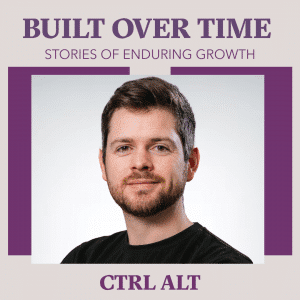
A market disruptor that plays by the rules
There’s a well-thumbed playbook for tech startups that goes something like this: announce plans to disrupt an established market, and portray regulation and regulators as burdensome obstacles to progress. But Ctrl Alt is writing its own story and playing by different rules. Its team come from finance and regulatory backgrounds including Morgan Stanley and Credit Suisse. Since it was founded in 2022, the company has been carefully gathering the appropriate licences and permissions it needs to operate, intentionally building its identity around understanding and operating within the rules, not avoiding them.
“We’ve come at this from a regulatory-first approach,” confirms Jordan McMullen, Chief Operating Officer. “We’ve made sure that we look at everything through the lens of the regulator and make sure it’s appropriate for the solution we’re creating.”
Ctrl Alt currently operates inside the Bank of England and FCA’s Digital Securities Sandbox (DSS), and has secured direct UK authorisation. It holds a virtual assets licence in the UAE and is in the process of securing a financial licence in Ireland. These aren’t the actions of a company trying to outrun regulators but of one that speaks their language, and it’s why Ctrl Alt has won the trust of the governments and financial institutions on its customer list.
Disrupting financial services
The company provides tokenisation solutions, which is one of the hottest concepts in financial services. This involves subdividing large assets that normally need a lot of capital to invest in or acquire into smaller amounts or ‘tokens’. This opens up the field to larger numbers of smaller investors who otherwise wouldn’t have the financial firepower to do so. It also reduces the friction and time delays traditionally associated with securities trading.
Today, most financial securities transactions settle on a T+2 basis: a two-day delay built into the system largely because legacy infrastructure demands it. Tokenisation compresses that timeline by creating a single, tamper-proof record of ownership accessible to all market participants simultaneously on the blockchain, which is a digital ledger.
Fund investment, a process that currently involves numerous intermediaries, significant friction, and minimum ticket sizes that can run to tens of millions. Ctrl Alt can tokenise those funds so that investors with smaller allocations of one or five million can participate, broadening the capital base and reducing barriers to entry.
A world-first in asset ownership
A vivid demonstration of the technology’s potential came when Ctrl Alt partnered with the Dubai Land Department to become the first company in the world to issue a token as a legal title deed on a public blockchain. In the UK, it was the first company to tokenise a house, issuing tokens to 45 investors as proof of their fractional ownership.
In another unexpected turn, the company’s largest base is not in a major financial district. Its headquarters is in London, where it was founded and launched, and it also has a European base in Dundalk and operations in Dubai. But most of the staff are actually based in Belfast, where it now has engineering, finance and ops teams.
It wasn’t planned that way: in early 2024, there were just three people working for Ctrl Alt in Northern Ireland and no formal office. The assumption was that new recruits would work remotely, but as the team grew, something unexpected happened. “As we were hiring people, they were saying they want to spend time together and work together in person,” Jordan recalls. Mondays, Tuesdays, and Thursdays have become the natural rhythm for most of the team in Belfast.
A culture built to endure
Ctrl Alt is taking care to recruit people who will understand and contribute to the culture as the company moves beyond its startup phase. “It’s very important for us that we get our hires right,” Jordan agrees. “Being the 51st or 52nd person in a business, you’re coming in at what’s still a relatively early stage and when the team grows to 200, you have an idea of how the business ties together. So we focus on, and we make sure through the interview process, that candidates fully understand how our business works. We want to see excitement for what we’re building, that people feel motivated by the pace we create things and to be leaders in our space.”
For a company growing at this rapid rate, the question of office space could easily become a costly distraction, or worse, a brake on its momentum. A conventional agreement of even two or three years would have been untenable. “We’d be sitting with a lease where we’d have to try to find somebody else to take it. It would be a massive resource drain,” Jordan admits.
Flexible space facilitating fast growth
Flexibility was the order of the day, and Ctrl Alt found an accommodating partner in Glandore. In May 2024, Ctrl Alt signed with Glandore for a six-person office. By October, the team had moved to a 15-person suite. By March of the following year, there was an upgrade to accommodate 25 people. Shortly after, they removed the wall between their new office and their old one to create what Jordan describes as a “super office”. The company’s fifth move with Glandore, across the road to Arthur Place, came in early 2026.
That’s five office moves in roughly 18 months. And when those moves happened, there was no fuss. Glandore made it happen within days, relocating furniture, equipment, and infrastructure with minimal disruption to the team. “For a startup where we don’t actually want to focus on the office administration side of things, Glandore have just been brilliant,” Jordan says.
In the early days, when Ctrl Alt had no meeting rooms or phone booths of its own, Glandore responded rapidly to provide them. One of its other requests was a little less conventional. “We’re a business that loves a whiteboard. Glandore can provide large whiteboards but they typically will have a wall or feature painted. We told them we really liked that, so they painted the entire wall,” Jordan explains.
Working out problems with a pen
Spanning over 15 metres, the specially coated surface gives the team a continuous surface for visually working through solving client problems or developing product ideas. “We move exceptionally quickly for our clients. If there’s a deadline they need to achieve, being able to get into a room and smash things out makes a big difference,” Jordan says.
With its office needs met, Ctrl Alt has another reason to keep up the Belfast office’s rise in prominence within the company. So far, the city has been a rich source of ambitious talent who are genuinely excited about building something significant, and to retain them with a culture that offers more responsibility, faster progression, and greater proximity to decision-making than many employers can match.
“We’ve been able to find talented people in Belfast who are keen to get stuck in and build something exciting. We find really strong pools of candidates who want to come and work with us, Jordan says. “There are very few businesses that get to work so closely with the FCA and the Bank of England. We’re at the forefront of digital assets and the future of finance. A lot of people might not have heard of tokenisation so far but the word will become much more commonplace. If you think about how quickly we moved to smartphone adoption, which was something people couldn’t envisage at the time, tokenisation will become that norm as well.”
No less a figure than BlackRock CEO Larry Fink has publicly said that all assets will eventually be tokenised. For Ctrl Alt, that kind of institutional validation confirms the feeling that they’re on the right side of a growing movement. “This is very much being looked at globally as transformative technology for the financial sector,” Jordan adds. “We feel that we’re on the cusp of a big revolution.”
Ctrl Alt expects to be at the heart of that revolution in ownership, investment and financial infrastructure: not as a noisy upstart challenger but as a credible, regulated, trusted player. And with plans to grow to 100 people by 2027, it’s safe to say plenty more ideas will start life on the wall-length whiteboard in Belfast.
More about Built Over Time: Stories of Enduring Growth
In an economy consumed with rapid growth, enduring growth is often misunderstood. The businesses that last are rarely those chasing momentum alone, but those built with patience, discipline and a clear sense of direction. Built Over Time looks beyond the startup narrative to examine how established companies grow in practice, expanding teams, deepening capability and adapting to change without losing what makes them work. Flexible workspaces provide the foundations for this kind of growth, offering the adaptability, infrastructure, and environment that allow teams to scale efficiently while maintaining focus. Through the experiences of organisations operating at scale, this series examines the decisions, structures, and long-term thinking required to build businesses designed to endure.