
Built Over Time: Stories of Enduring Growth
Qumulo
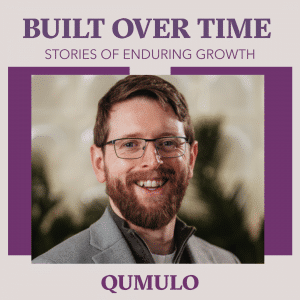
Qumulo in Cork: from history and heritage to talent and technology
When technology companies decide where to build their next engineering hub, they usually talk about talent, infrastructure and opportunity, but history can matter just as much.
In Qumulo’s case, the two are closely linked. Qumulo builds the software that large organisations use to store and manage their unstructured data: the video, images, scans, sensor readings and research files that don’t fit neatly into rows and columns. Headquartered in Seattle, it serves customers worldwide, running on-premises and across the public cloud.
So when Qumulo looked for a European engineering base, it could have chosen any number of established technology centres. Instead, it chose Cork, drawn by decades of storage and enterprise software expertise, a thriving talent pool, and a technology ecosystem that continues to evolve.
As Diarmaid Hogan, Qumulo’s Cork site leader and Director of Engineering describes it, the city offers plenty of computer science talent: ideal for a site with a strong leaning towards engineering.
After hiring four customer success professionals remotely, the company established its Cork office in spring 2026 as its European engineering and R&D hub. The initial plan is to create at least 50 new roles over three years, but Diarmaid expects that figure to grow. “Our leadership and the executive team are very excited about what we’re doing in Ireland,” he says.
Attracting talent with culture
“The standards in Qumulo are very high,” Diarmaid says. “We’ve been selective because we want exceptional engineers, and Cork gives us access to exactly that. There are talented people already here, along with professionals relocating from across Europe who see Cork as a great place to build both a career and a life.”
The company’s engineering-led culture also makes it attractive to new hires, even as a relatively recent entrant. “Qumulo has a huge culture around ownership and acting like an owner. Compared to different software corporate philosophies over the last 20 years, our engineers are encouraged to be responsible for their own code. There’s a flat hierarchy, with people kept accountable for their own work,” Diarmaid explains.
Space to grow sustainably
The Cork team operates from a flexible workspace at Glandore’s Lapps Quay location overlooking the River Lee. For Qumulo, this is a deliberate strategic move that underpins its recruitment and operations. New hires moving to Cork can live centrally without immediately needing a car, and existing local staff members value the ability to step out for coffee, errands, or after-work meetups. For engineers who spent years working fully remotely, the chance to re-engage in a truly collaborative, in-person environment has been a strong draw, Diarmaid says.
“My own experience of seeing Cork evolve is that, 15 years ago, nobody was in the city. Now everybody’s in the city. And from a talent and a people perspective, I think people enjoy the city centre working lifestyle,” he says.
For many companies in their early stages, combining a prime city-centre location with the flexibility to grow can be a challenge. For this, Diarmaid can lean on Glandore’s team for front-of-house, facilities, and event support rather than having to build that capability in-house from day one. When Qumulo hosted its official launch event and announcement with IDA Ireland, the Government’s inward investment agency, Glandore’s local support proved invaluable.
A flexible working model
Equally important is the scalability that Glandore’s model offers. At the time of writing, Qumulo has just moved from the original 16-person space into two offices with space for 30 with added flexibility as the company’s headcount grows. Rather than locking into a multi-year, fixed-size lease before the team’s shape and cadence are fully known, the company can expand progressively within the same high-quality environment.
Qumulo’s Cork office operates on a hybrid model, with a default of three days in the office and the rest remote. For a “greenfield” site building a new culture, Diarmaid believes regular contact is essential: people sitting side by side, building relationships, and learning how to collaborate before defaulting to software tools like Slack and Zoom. At the same time, flexibility is built into the ethos: employees are trusted to manage personal commitments, and the expectation is that the give-and-take runs both ways when deadlines or incidents demand extra effort.
AI hasn’t replaced human collaboration
Qumulo finds the rise of AI tooling is reinforcing the value of physical proximity. Instead of lone developers at home “talking to a bot all day”, the pattern in Cork is teams huddled together, architecting systems, discussing problems together, and designing solutions. AI agents handle repetitive coding tasks, but the creative work, such as architecture, trade-offs, and decision-making, remain human.
Critical thinking is still a vital human attribute that Qumulo values, Diarmaid says. “We’re seeing engineers do early-stage prototyping 10-15 times faster, while production delivery is still two to two-and-a-half times faster once you slow down and harden the code. The low-value boilerplate work is automated away, but smart people using the right tools to solve hard problems are more important than ever.”
This explains why Diarmaid has a more nuanced take on the technology trend, even as some doomsayers predict devastation in the jobs market from AI’s advances. “This is just the landscape of the world now. These tools have become part of the ecosystem. When I was in university back in 2008, everyone was freaked out about Wikipedia! They were saying: ‘You tell me there’s an online resource that people can copy and paste, and we have no idea if they actually understand what they’re copying and pasting?’ How is that any different to AI? The reality is, smart people use tools: engineers are problem solvers, and will always solve problems. It’s just the type of problems that they will solve, I think, will be different.”